A Seminar Focused on The Finance Behind Global Health Initiatives

A Seminar Focused on The Finance Behind Global Health Initiatives

The Seminar Series: Stories From Africa, Financing Health in Sub-Saharan Africa took place at Duke University on Thursday, October 18. Led by Gavin Yamey, the seminar featured a panel of speakers: Sarah Bermeo, Associate Professor of Political Science, Duke Sanford School of Public Policy; Charles Muiruri Program Director at Duke Global Health Institute and Co-founder Association of Research Administrators in Africa; Kaci Kennedy, Associate Research, Duke Center for Policy Impact in Global Health; Godfrey Kisigo, Masters Student DGHO, Physician at Kilimanjaro Clinical Research Institute, Tanzania; and Osondu Ogbuoji, Deputy Director, Duke Center for Policy Impact in Global Health. The seminar opened with an introduction to global health from a very optimistic perspective. Global health is a cutting edge field that focuses largely on improving the future for humanity. Initiatives in global health are making large and wide impacts, for example, in fields such as child wellness. However, there are also still huge numbers of people suffering from illnesses and burdens that...
Read More
Embracing My Role as a Researcher – Sharing My Small Slice of the HPV Research Pie

Embracing My Role as a Researcher – Sharing My Small Slice of the HPV Research Pie

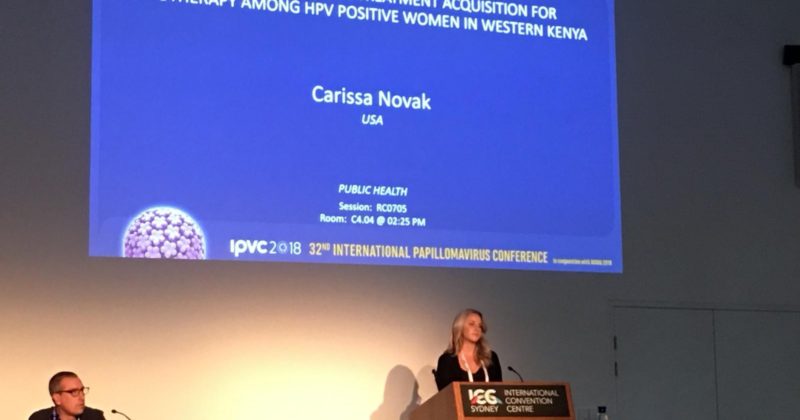
Guest Blog: Carissa Novak Throughout my recently completed Masters in Global Health Science, Duke’s Global Health Institute faculty regularly stressed the importance and potential impact of disseminating research findings. Therefore, I felt presenting the research findings from my thesis at the 32nd International Papillomavirus Conference inSydney, Australia, this fall was not only appropriate but necessary. Due to ongoing conversations regarding HPV vaccination coverage and HPV screening for cervical cancer communities are witnessing a tremendous increase in screening rates, especially in low-resource settings, where cervical cancer is most common. However, most programs still face significant challenges in addressing HPV positive women’s low rates of follow-up and treatment. My attendance at the conference was an opportunity to share the findings of my thesis work, in which we found that in western Kenya, a setting where resources were limited for all HPV positive women, stigma and isolation were the main differentiating features between women who accessed follow-up and those who did not. Interestingly, I presented...
Read More
When Social Constructs Incorrectly Assume Scientific Validity: The Myth of Virginity and Incidence of “Virginity Testing”

When Social Constructs Incorrectly Assume Scientific Validity: The Myth of Virginity and Incidence of “Virginity Testing”

This past Wednesday, the United Nations called for the end of a practice known as “virginity testing,” declaring such tests a violation of human rights. While these tests possess zero scientific merit or clinical foundation, they are still performed in nearly 20 countries, including but not limited to India, Brazil, Afghanistan, South Africa, Iran, Iraq, Sri Lanka, Turkey, Northern Ireland, and Jordan. Virginity testing entails a physical examination of the hymen, usually by an insertion of fingers, to determine whether a woman has had sex. However, such measures are incapable of determining whether a woman has had intercourse or not, and reinforce the anatomically incorrect term “intact hymen.” Furthermore, as delineated in the UN’s statement, this test, "further reinforces socio-cultural norms that perpetuate women’s inequality, including stereotyped views of female morality and sexuality, and serves to exercise control over women and girls." In short, "virginity testing" robs women of the right to protection from discrimination, and of the right to...
Read More
Family Planning Use in East Africa

Family Planning Use in East Africa

Family planning (FP) is critical in the promotion of community health. It is an intervention that is proven to save lives and foster development. Research supports the notion that family planning is directly linked to improvement in maternal and child health in addition to socio-economic progress. Understanding the unmet need for family planning services is key to improving worldwide reproductive health. During the last three decades in East Africa, research shows that Kenya and Rwanda are clear leaders in regards to access to and use of contraception. These two countries have a history of implementing targeted and focused programs to improve access to FP services. FP differs in each country in ways such as the amount of methods offered and the extent to which each method is available. Across the sub-region there is an increase in the use of modern contraceptives. But, a steady proportion of women in Ethiopia, Rwanda, and Tanzania are still using traditional methods. While short-term contraception is frequent in the sub-region, there is...
Read More
Sharp Rise in C-Section Births Around the Globe

Sharp Rise in C-Section Births Around the Globe

A study recently published in The Lancet journal reveals that from 2000 to 2015 there has been approximately a double in the number of cesarean section (C-section) births in the world. C-section births occur when a surgery is performed to open a woman’s lower abdomen and remove the baby. These procedures can either be planned in advance or they can happen suddenly if problems occur during birthing. There are risks to C-section births for the woman, such as infection and postpartum heavy bleeding, and the baby, such as trouble breathing and injury. Additionally, C-sections create a more complicated labor recovery for the mother and pose a threat to future labor complications. The figures from the study state that in 2000 C-sections accounted for 12.1% of all births and in 2015 they accounted for 21.1% of all births. There is evidence published by the World Health Organization stating that there is "no justification for any region to have a caesarean section...
Read More
The Girl Child’s Present Colors Her Future: The International Day of the Girl Child

The Girl Child’s Present Colors Her Future: The International Day of the Girl Child

October 11th, 2018 marked the sixth annual International Day of the Girl Child, a celebration which works to establish investment in girls as essential to a sustainable and thriving community.  This holiday occurred at a crucial intersection within both a domestic and global narrative. From the election of Brett Kavanaugh to the growing momentum of #MeToo and #WhyIDidn’tReport, sexual violence and other gender disparities have been thrust into the center of public dialogue, igniting the fires of social change. However, to dismantle the culture and practices which systematically devalue women in their present, we must first protect the girl child, as her condition, positive or negative, will ultimately inform her future. This year’s theme of the international day was “With Her: A Skilled GirlForce,” which drew attention to the 25% of unemployed youth, disproportionately consisting of girls. This disadvantaged demographic of girls in the workforce is especially vulnerable to both monetary and sexual exploitation. The very derivation of gender equality...
Read More
California Governor Vetoes Abortion Bill

California Governor Vetoes Abortion Bill

Governor Jerry Brown recently vetoed a bill that would have required all health centers at University of California and California State University schools to offer prescription abortion pills. Introduced in February 2017, Senate Bill 320 would have made California the first state to require access to medication abortion at public universities. Medication abortion was approved by the FDA in 2000, and currently accounts for one-third of abortions in the United States. A combination of two drugs, mifepristone and misoprostol, allows the patient to undergo the procedure in their own home. In spite of years of research deeming the procedure safe, thirty-four states heavily regulate medication abortion by requiring licensed physicians, rather than midwives or nurse practitioners, to administer the drugs. In spite of living in a state with otherwise progressive abortion legislation, women at public universities in California often have restricted access to abortion options. More than 500 women at California's public universities seek the abortion pill at off-site healthcare providers every...
Read More
WORLD CONTRACEPTION DAY CELEBRATION AT KISUMU COUNTY

WORLD CONTRACEPTION DAY CELEBRATION AT KISUMU COUNTY

World Contraception Day annually takes place on September 26th. The worldwide campaign is centered on a vision where every pregnancy is planned and wanted. This year, Kisumu County joined the rest of the world in celebration at the Simba Opepo Dispensary. County officials and over 10 partners attended, with Deputy Governor Dr. Mathews Owino as the chief guest; he expressed commitment to the county leadership and its growth. The community came together to promote and echo important actions on Family Planning (FP) and contraceptives, improve awareness on contraception, and enable young people to make informed reproductive health choices. Healthcare workers were encouraged to support clients in selecting appropriate FP methods and discussing possible side effects. There is a need in the community for counseling on correct methods and their associated potential warning signs. Further, the celebration called for the mentoring of healthcare workers in order for them to have the right attitude towards youths. This attitude will allow patients to freely walk into...
Read More
The Alarming Incidence of Unsafe Abortion Worldwide

The Alarming Incidence of Unsafe Abortion Worldwide

Approximately 56 million abortions are performed globally each year, with half of these procedures falling upon some continuum of danger that they pose. 97% of these unsafe abortions are performed in low-income countries within Africa, Asia, and Latin America, illustrating the enormous reproductive health disparity borne by geographic location. Abortions are classified by the World Health Organization as “safe”, “less safe”, and “least safe.” Many abortions conducted in developing countries are qualified as “least safe,” characterized by the insertion of foreign objects such as sticks and broken glass bottles, or the ingestion of harmful cleaning products. Ultimately, 6.9 million women each year are treated for complications attributed to unsafe abortions, and 23,000 women die from such complications. Yet, safe abortion procedures such as manual evacuation and abortion-inducing drugs are not financially out of reach even for low-resource countries. Thus, the solution to this horrific lapse in reproductive health lies in political discourse. While some countries, such as Ethiopia and Nepal,...
Read More
Partner Updates: Uganda

Partner Updates: Uganda

Our Ugandan colleagues at the Makerere College of Health Sciences have been busy over the past few months. Center members’ work has focused on various aspects of cervical cancer, from prevention to diagnosis and treatment. Dr. Miriam Nakalembe is still leading the NCI-funded effort to evaluate community-based strategies for cervical cancer detection, in partnership with Dr. Megan Huchko. Building on this work, she is a co-investigator on a recently funded two-year project through the Fogarty International Center. The grant seeks to develop a portable imaging technique, called a smartphone confocal endoscope. The new technology would visualize cellular details of human cervix in vivo without taking a biopsy, and after validation would be adapted to provide a low-cost diagnostic tool for other diseases in both resource poor and resource rich settings. Dr. Jane Namugga continues her work with Dr. Paula Lee. The pair have completed data collection for a project to determine rates of completion and adverse events associated with receiving chemotherapy...
Read More