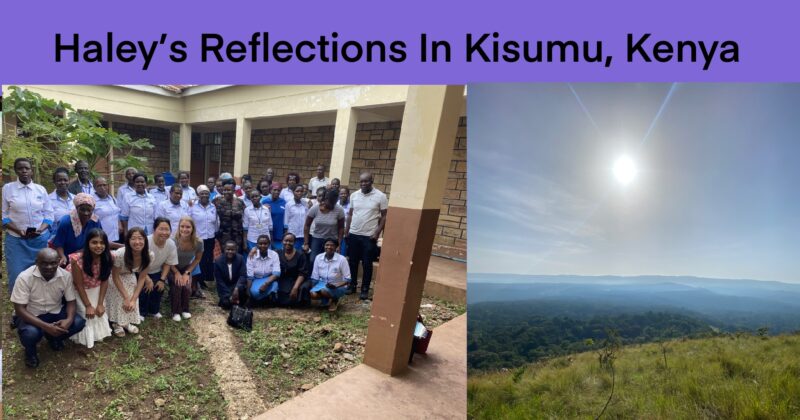
As we start our eighth and final week in Kisumu, the SRT team is finishing up the last stages of our on-the-ground research, and preparing for our trip back to the US! At this point in time, we are almost finished with our clinic observations. Despite several scheduling changes, we will complete our project with five to six observation sessions at each of the six clinics. Additionally, we have set in motion the plans for the Kisumu team to conduct focus group discussions (FGDs) at the intervention clinics after we leave. The purpose of the FGDs is to understand women’s opinions about our educational intervention, and how they feel about incorporating peer navigation services into the clinics. Unfortunately, we will not be here to witness the FGDs as we originally anticipated, but we’ve been working on setting everything up so that they will run smoothly in our absence. That includes getting participant recruitment up and running, going over our questions and...
Pictured above: People marching in Boulder, Colorado for Reproductive Health Rights in May of 2022 with signs that say “Your right to abortion should not depend on your zip code.” Unfortunately, though, zip codes shaping access to abortions may very much be more of a reality with the overturning of Roe v. Wade. The New York Times reveals how the Supreme Court’s ruling on the Mississippi law could weaken or even overturn Roe v. Wade which could ultimately lead to legal abortion access dramatically decreasing, particularly in the American South and Midwest (Bui et al., 2021). This geographic discrepancy is even more reinforced through social class differences and communities that are “disproportionately Black, Latina, teenagers, uninsured, and undocumented immigrants” (Miller & Sanger-Katz, 2022). Ultimately, leading not only to be a social justice issue and human rights issue, but also a racial justice issue. Bui et al. quotes Caitlin Knowles Myers saying, “A post Roe-United States isn’t one in which abortion isn’t...
First and foremost, we have passed the halfway point of our time in Kenya! Time flies by, and we are discussing what we want to get out of the next four weeks. Insofar, we collected more than 20 observation data to evaluate the workflow of stigma education at the clinic. During this process, we faced multiple hiccups, especially scheduling a visit and clearing up logistics. Three of our observation clinics had a twelve-day-long CHV training, so we had to flip our schedule to ensure we could collect the data we initially planned. We spent the last couple of days creating a contingency plan so that our time in Kenya could contribute to the depth of our data. Listening to what other teammates thought helped us, as a team, solidify the future direction of our study, such as what variables to analyze in observation studies, codes for focus group discussion, and the focus of our manuscript. Besides working on an observational study,...
We have made it through week three of our time in Kisumu, Kenya! The weeks are truly flying by because our research is progressing, and we are enjoying our time in the city. The other SRT students and I officially started our workflow analysis observations at each of the six clinics this past week. There are three intervention clinics, at which community health volunteers (CHVs) display an educational video about human-papillomavirus (HPV) self-screening, and three control clinics, where CHVs provide health education talks about HPV and offer the self-screening. Through our observations so far, it is clear that all the CHVs are quick learning, adaptable, and passionate about increasing HPV screening for women in Kisumu! We have enjoyed our first week of observations because of all the positive aspects we have seen with our study. Fortunately, many women are opting into HPV self-screening, and we are able to increase prevention of cervical cancer in many of the Kisumu sub-counties! We...
Sunday marked the first full week that the rest of the students from the Kenyan Reproductive Health SRT team and I have been in Kisumu, Kenya. Our experience thus far has been full of introductions and familiarizations, and we have had an exciting time learning from the field while finding our footing in a new area. After we flew into Kisumu, we were able to get situated in our new living space and learn to make ourselves at home for the next two months, starting to cook for ourselves and establishing new rituals (like bonding through watching Suits together during dinner). We have learned to navigate some parts of the town with the help of our local partners, learning where to buy groceries and hot meals, and we have done a bit of exploring on the weekends and our walks to work. Although moving to an unfamiliar area has been challenging, we have been able to improvise and overcome to...
Jonas Swartz, MD, MPH is an OB/GYN and an Assistant Professor of Obstetrics and Gynecology. He completed his undergrad at Duke University and then his MPH and MD at the University of North Carolina at Chapel Hill. He completed his residency in Obstetrics and Gynecology at the Oregon Health and Science University, followed with a fellowship in Complex Family Planning back at UNC. I had a conversation with Dr. Swartz to understand more about how he became involved in health policy and reproductive health access. “Well, I grew up in North Carolina and did Medical School here, and one of the striking things when I was a medical student was the discrepancy in care during pregnancy for people who were citizens versus non-citizens. And, in particular, thinking about low-income people who use Medicaid.” Swartz described his early medical training and becoming acquainted with the Federal Emergency Medicaid program, which only pays for labor and delivery services for authorized immigrants. He noted that...
This summer, 4 students will join the Center as part of the Student Research Training Program (SRT). Hear their thoughts heading into the program.
Bentley Choi
When I first applied to the SRT program, I merely expected to ‘conduct’ research abroad. In reality, I learned more important skills such as writing IRB amendments, scheduling a meeting with teammates, and communicating with a research team in Kisumu. My goal for this summer is to apply what I learned from Dr. Eric Green’s Global Health Research Methods class into a real-life setting, and I believe we are making our way to this goal since the team proposed a new way to evaluate the intervention! I look forward to conducting observational study and focus group discussions. Also, I am hoping to learn how to navigate myself in a new living environment and what are Kenya’s unique cultural factors that influence stigma and perception towards reproductive health since it is also related to my senior thesis...
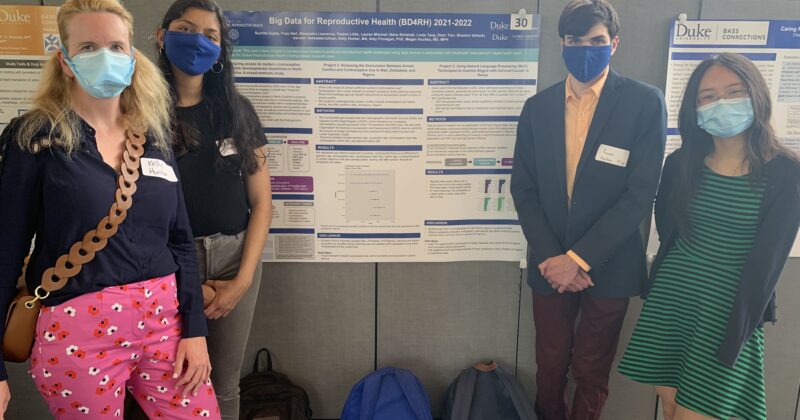
Our Big Data for Reproductive Health Bass Connections team worked on three teams throughout the year and presented their work at the Bass Connections Showcase. Using Natural Language Processing (NLP) Techniques to examine Stigma with Cervical Cancer in Kenya
Members: Foxx Hart, Lynne Wang, Alexandra Lawerence, and Neha Shrishail For our project, we utilized topic modeling to identify recurring themes and sentiments in HIV interview data with Kenyan women, as well as develop an understanding of stigma frameworks. This year we were able to learn new technical and project management skills while diving deeper into the emerging interdisciplinary space between quantitative machine learning and qualitative social science research. Due to the many nuances and complexities involved with categorizing stigma, we have concluded that rudimentary NLP is not sufficient for identifying the various forms of stigma in qualitative data. However, we believe that this was a great introduction to applying these methods to an important area in global reproductive health. We hope more research...
May is a time of growth and excitement, from magnolia blooms and longer, warmer days to the celebrations popping up around campus. Along with the inherent optimism of spring on Duke’s campus, it feels that we are starting to sense what life in a more stable peri-Covid world will look like. For many, getting together in person to celebrate events and achievements, or even just to brainstorm in the same room, is a salve after these past two years. Graduation and summer opportunities provide a blank canvas for new experiences and adventures for students. This year’s graduating class spent much of their time at Duke in conditions altered by the pandemic, and yet most of the ones that I have worked with have not let that hinder their ambition or achievements. Their resilience, flexibility and grace will serve them well. In fact, the confluence of the pandemic and the national reckoning with race and racism that has so profoundly impacted...
Our paper, “Uptake and correlates of cervical cancer screening among women attending a community-based multi-disease health campaign in Kenya,” is published in the BMC Women’s Health. In this paper, we describe the acceptability and uptake of a model of integrated HPV-based cervical cancer screening as part of a series of multi-disease community health campaigns offered in Kisumu, Kenya. We also describe the prevalence and predictors of both screening and positive HPV results among women attending these campaigns. Although there is an increased risk of cervical cancer among women living with HIV, many HIV-care programs do not offer integrated cervical cancer screening. To address the cervical cancer screening gap in Kenya, we leveraged the community health campaigns facilitated by the Family AIDS Care & Education Services and provided multi-disease testing to achieve a high population coverage for HIV-testing and HPV-based cervical cancer screening in western Kenya, an area with high rates of HIV. In addition to HIV testing, the campaigns provided screening...