While the use of modern methods of contraception are now commonplace in many countries, one-third of women in developing countries who begin using a modern method of contraception quit within the first year and half quit within two years[i]. Most discontinuation occurs among women who want to avoid pregnancy putting them at risk for unwanted pregnancies, maternal morbidity and mortality[ii]. Traditional measures of contraceptive use are collected retrospectively from population representative surveys conducted only every five years which are not well-suited to measuring contemporary trends in contraceptive discontinuation. This is problematic because advocates and health ministries cannot address concerns in a reasonable amount of time to impact widespread change. "Big Data" can supplement these static sources by providing dynamic, real time tracking of the reasons women discontinue using contraceptives and open up possibilities to prevent discontinuation or help facilitate switching between methods. So what exactly is "Big Data" and how can it supplement traditional reproductive health data? Big data is commonly thought...
"Curious about contraceptive discontinuation? Intrigued by intersections of technology and sexual health? Apply to join the Data+ “Big Data for Reproductive Health” team! This summer, participants will collaborate with Duke Global Health Institute reproductive health investigators, producing a digital resource that repackages basic Demographic and Health Surveys (DHS) information on contraceptive discontinuation as actionable intelligence for family planning organizations. During the 10-week program, students will also seek feedback from RTI researchers and determine appropriate distribution tactics for their social media-integrated platform. Like other Data+ programs, this project is interdisciplinary, combining the fields of computer science, global health, gender, sexuality and feminist studies, public policy and, of course, data. To find out more and apply, click here."...
Faculty Profile: Blandina Mmbaga
Dr. Blandina Mmbaga is the Director of the Kilimanjaro Clinical Research Institute and a pediatrician at the Kilimanjaro Christian Medical Center (KCMC). She has collaborated with Duke University for over 10 years and currently serves as a site leader for the KCMC-Duke collaboration. Her work in reproductive health includes evaluating strategies to prevent mother-to-child-transmission of HIV and working to improve transitions of care and addressing RH needs for perinatally infected adolescents. We sat down with Dr. Blandina Mmbaga to talk about her work in Tanzania and what she believes are some of the biggest reproductive health challenges in her region.
What are the key reproductive health priorities for Tanzania?
Dr. Mmbaga described several systemic health challenges such as infant nutrition, maternal health, and unmet need for family planning. She feels that one of the biggest challenges, despite available treatment mechanisms, is the prevention of mother to child transmission of HIV. “It remains a challenge because there are still new infections”....
This summer, after a long, solo trip across the world, I arrived in East Africa for the first time. As a Master of Science in Global Health student at Duke University, I spent my first year paired with a mentor, Dr. Megan Huchko, working as a research assistant. During that time we worked together to design a research study which I would conduct the following summer in Kenya. Dr. Huchko and I chose to interview HPV positive women from her ongoing cluster-randomized trial to find ways to reduce the substantial loss to follow up seen with a two-visit screen and treat strategy. Upon entering this program, I knew I wanted to work in women’s reproductive health. Cervical cancer is the leading cause of cancer in women in Africa, so having the opportunity to have a hand in research being conducted to reduce that burden is a privilege. Our goal was to improve treatment acquisition among HPV positive women, to reduce...
What is the function of the clitoris? Before I began teaching comprehensive sexuality education (CSE) at WISER Girls’, a secondary school located in Muhuru Bay, Kenya, I never imagined that this would be the most frequently asked question. Especially among a class of female third-year high school students. When I was first asked, I gave a cursory – and yes, somewhat bashful – reply, explaining the clitoris as the “anatomical source of sexual pleasure in females.” But this answer did not satisfy the students, and they probed for more information. As we engaged in a discussion, I learned that many weren’t familiar with an external representation of the female genitalia – especially one with a “non-reproductive” function. As my answers became more justificatory about the significance of the clitoris, I realized that my attitudes about legitimized female sexuality had begun to leak into my responses. While I tried to remove any bias from my answers, I struggled with leaving my...
On Friday, October 20th, public health professionals from around the Triangle gathered at Duke to discuss how best to advance women’s health in the current political environment. Keynote speeches were given by Jen Kates, Vice President and Director of Global HIV Policy at the Kaiser Family Foundation, and North Carolina Congressman David Price. Women’s health right now is in an era of uncertainty. Jen Kates focused on this as she outlined many of the questions that remain regarding how the Trump administration will implement many of its proposed changes to global health policy. Unfortunately, this uncertainty extends to women’s health domestically as well. Congressman David Price described expected and potential changes to the Affordable Care Act and the devastating effect these could have on women and girls across the United States. After hearing a broad overview, the afternoon concluded with two panels which honed in on specific impacts current and proposed policies will have. Lindsay Robinson of Planned Parenthood South Atlantic reminded...
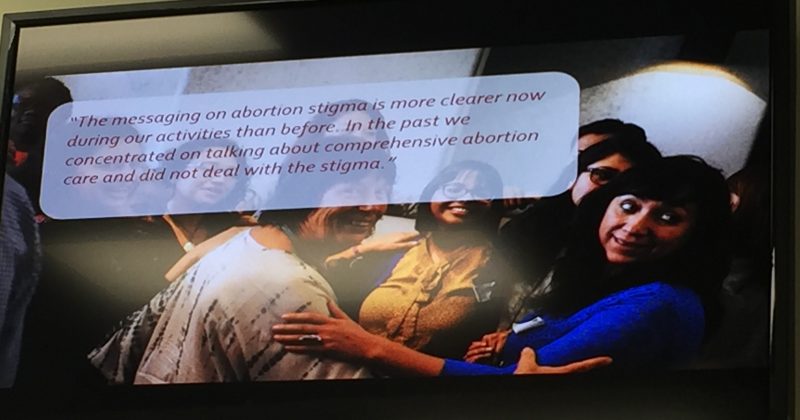
This year, we will host a series of reproductive health talks. These talks are designed to expose audience members to a broad range of reproductive health topics, organizations, researchers, and projects. The first talk of the semester was facilitated by the co-conveners of Inroads. Kati LeTourneau and Katie Gillum gave an engaging presentation on their work and how individuals and organizations are combatting abortion stigma around the world. Rather than being a network of organizations, the Inroads network is comprised of individual members. Gillum and LeTourneau stressed the importance of this, because “we interact with stigma as humans and individuals first” so transforming and dismantling stigma must start on an individual level. One of their goals is “to transform (stigma) by bringing people together who don’t often get together.” Each member brings their own expertise to the community, provides support to other members, and asks for guidance and feedback from the network. So why stigma? As Kati said, “Stigma is a barrier...
Cervical cancer is an example of a glaring health disparity between wealthy and poor countries, and remains an immediate health threat to many women in low- and middle-income countries (LMICs). Evidence-based, cost-effective protocols recommended by the World Health Organization have not been widely implemented due to limited health care infrastructure augmented by a lack of funding and political will. Although there are some unique factors contributing to the disparity in cervical cancer outcomes between high and LMICs, there are some common root causes shared across health systems: poor health care infrastructure, lack of awareness of early signs or symptoms, lack of funding prioritization within local governments, and limited operationalization of proven technologies used in high-income countries. These root causes must be addressed through both innovation and adaptation of successful interventions to fit the target community and the priorities of local governments (i.e. be both low-cost and cost-effective). To achieve this, clinicians and researchers need to partner with policy experts and...
When I landed in the airport in Kisumu, Kenya, I was brought back to the day I first left Kenya for the U.S. as a young girl. Although I have returned to Kenya since then, I was overwhelmed by this particular experience as I never envisioned returning to my home country as a college student pursuing research in a field I always knew I was passionate about. From an early age, I found myself burdened by the needs and suffering of women. Women who never put themselves first so I can be where I am today. After committing to the Global Health major at Duke, I began searching for a mentor to engage in a research project with that would challenge my problem-solving abilities, and provide me with ample support to learn independently. I connected with Dr. Megan Huchko, and spent a few weeks this summer with her Cervical Cancer Screening & Prevention study based in Migori, Kenya, while also shadowing...
When you hear the words ‘reproductive health’ what do you think of? Some may think of pregnancy, others the prevention of pregnancy. Maybe you think about the risk of HPV and cervical cancer, or the choice to decide your reproductive future. These are among the most important facets of reproductive health for both men and women. However reproductive health has much broader implications, and achieving optimal reproductive health can be challenging in many parts of the world. Pregnancy, contraception, safe motherhood, cervical cancer prevention, fertility goals, abortion, and gender-based violence are all facets of reproductive health that impact women throughout their lifespan. Access to education and youth-friendly health services help young women navigate the transition through adolescence to educational and economic empowerment while avoiding early pregnancy and exposure to STIs and HIV. Economic empowerment and respectful prenatal care ensure that women have a greater chance of deciding when to reproduce and doing so safely. Strengthening and streamlining health care infrastructure through innovative...