With classes back in session, the halls are flowing with students talking about the trials and triumphs of their summers—whether they were in the field, interning in DC, trying out consulting work or just had an amazing vacation. The new school year brings with it a sense of new beginning and purpose—and sometimes an overwhelming feeling of everything needing to get “scheduled” during these first weeks of September. A colleague recently started an email with the greeting: “did you have a relaxing or productive summer? I feel like it’s either one or the other.” It made me reflect on how we take advantage of being out of the classroom, trying to fit in various opportunities for travel, fieldwork and writing time that become harder during the semester, while also taking time to regroup and relax with family and friends. I hope everyone was able to have a little balance this summer, and come into the new school year with renewed...
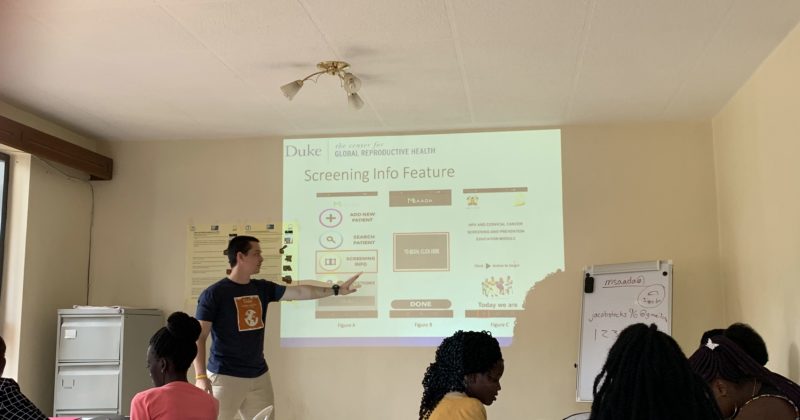
Fieldwork is all about learning, and sometimes that means learning things the hard way. My summer in Kenya taught me a lot about app development, about the process of global health research, and, of course, about myself. My apologies to those of you who have been following the student pieces throughout the summer, but I’ll give a quick summary of my thesis project for first time readers: mSaada is a mobile phone application intended for use by community health volunteers (CHVs) during cervical cancer screening in Western Kenya. The app has multiple features including patient education and counseling materials, protocol support for CHVs, and patient data collection capabilities, to name a few. We hope the app will increase patient understanding of HPV and cervical cancer and act as an efficient and effective resource for CHVs throughout the screening process, leading to greater uptake of cervical cancer screening and treatment services and ultimately improved health outcomes for Kenyan women. Since the app...
Abortion is a loaded term in the United States, conjuring up many years of history and debate from political, medical and social contexts. However, in Kenya, there are even more challenges around perception of and access to abortion and post-abortion care services. In 2010, the new Kenyan Constitution legalized abortion when a provider deems that life or health of a woman are in danger. Although this is less restrictive than previous legislation, abortion is generally considered illegal throughout the country. While post-abortion care has always been legal in Kenya, it remains stigmatized, particularly because most often post-abortion care occurs after unsafe abortions that are occurring in the community due to the current restrictive policies. Indeed, post-abortion care guidelines were restricted from use for a number of years due to worry that the post-abortion care guidelines would help individuals perform these services illegally and were just re-released in February of this year back to health facilities throughout the country. Despite the...
We came to Kisumu, Kenya expecting to work on a project we had poured hours of work into. After much time spent discussing our project, conducting lit reviews, and finalizing In-depth Interview questionnaires, it was disappointing to learn that we would not have our necessary approvals for our project until after our departure from Kisumu. While we are glad to know that our project is in amazing hands here at the Center for Global Reproductive Health, it was frustrating to come to terms with the fact that we would not be the ones to carry out the interview guides we had worked so hard on. As our time in Kisumu comes to a close, however, I am compelled to reflect on why this change of plans changed my trip for the better. Much discussion around research, especially when it comes to global health research, focuses on the importance of flexibility. Figuring out what to do when plans change and how to...
Choosing to come back to Kisumu, Kenya for my resident research project was an easy decision. I had worked in Kisumu over multiple years in medical school through the University of California, San Francisco – Family AIDS Care and Education Services, and had always known I wanted to return to continue to build on those relationships I had formed over the prior years. My research project, “Clinical Knowledge of Essential Maternal and Child Health Services in Kenya” involved interviewing health providers in Kisumu, Homa Bay, and Migori counties in western Kenya about their commodities, training, and knowledge around four maternal and child health topics – pre-eclampsia, postpartum hemorrhage, post-abortion care, and neonatal resuscitation. As I was awaiting my elective block, I looked forward to transitioning back into a research role after primarily focusing on my clinical work for the past two years during residency. Once I arrived, I realized that untangling my research and clinical roles was not as easy as...
This summer, I embarked on a trip to the lakeside city of Kisumu, Kenya to work with Dr. Megan Huchko and the Center for Global Reproductive Health on the development of a survey tool to measure cervical cancer and HPV stigma among HIV-positive women and health care providers. The first step in the research study would involve in-depth interviews (IDIs) to develop a framework for our survey tool. In preparation during the spring semester, fellow researcher Emma Mehlhop (T’21) and I produced four IDI guides which would lead the interviewers through our exploratory questions, and we even attended a training on qualitative interviews. I was eager to see our preparatory work come to fruition during the summer, as I was certain the study would continue moving forward at our intended pace. When our study on cervical cancer stigma had hiccups with the IRB approval and left us unable to move forward with the IDIs, Emma and I joined another study --...
Exactly six weeks ago I spent my first full day in Kisumu, Kenya after a day’s worth of travel, an earlier than expected arrival, meeting my two Canadian housemates, and being so disoriented I didn’t even know where to get a meal or buy groceries. Now, with only two weeks of my time left, it’s almost laughable thinking back on how little I knew of how this city works. I now know which water to buy (the refillable 5L jugs with the handle), how much a tuk tuk from home to the office costs (100 KES, which is the equivalent of about 1 USD), and how to catch the best sunsets every night (rooftop of the building at our complex at 6:30pm). Despite my confusion on just about everything when I first arrived, the one thing I expected to be relatively straight forward was the research project I was set to be working on. I was told to be ready to...
Together with Duke SRT students, undergraduate app developers, and Kenya-based members of the Center for Global Reproductive Health, I will be leading a pilot usability study of an integrated digital platform called mSaada. The goal of this platform, placed in the hands of community health volunteers (CHVs) during HPV-based cervical cancer screening, is to help facilitate the successful completion of the cervical cancer prevention cascade. This will be achieved by mSaada’s many features: patient education, protocol and counseling support for CHVs, results notification, service reminders, and patient tracking. Over the course of the summer, we will train CHVs on proper use of mSaada, allow them to use the app in a clinical setting, and gather periodic feedback through quantitative questionnaires and structured in-depth interviews. We aim to gain a strong understanding of user experience, acceptability, and feasibility of the mSaada platform within the context of Western Kenya. My interest in this project is multifactorial. First, by studying and working to combat...
Last week the office at the Duke Center for Reproductive Health in Kisumu held a two-day qualitative research training session led by facilitators Cyrilla Amanya and Muli Emmanuel from ACE, Africa. Attendees included the Duke Reproductive Health Center’s Kisumu staff, a DGHI master’s student, and members of the Duke Global Health Institute’s (DGHI) Student Research Training Program (SRT). The members of SRT (Andrea Chalem, Suzanna Larkin, and I) are here in Kisumu, Kenya for 8 weeks working on two different studies concerning cervical cancer awareness, screening, and prevention. Andrea is working on an mHealth study with Jacob Stocks, a master’s student at DGHI, and Suzanna and I are working on a stigma study. We used the In-Depth Interviews (IDIs) created for the stigma project as a jumping off point for discussion and role play during the qualitative training session. On day one, we learned helpful tips on how to make interviews conversational and comfortable for the participant. These included using the...
"In 2011 the Rwandan government embarked on a novel medical education program to improve their health care system. Human Resources for Health (HRH) Rwanda, a partnership between the government of Rwanda and a consortium of 22 U.S. academic institutions, was designed as a 7-year training program to produce qualified medical personnel with the aim of increasing quality and access to health care for Rwandans." As one of the earliest ob/gyn specialists to work in Rwanda with HRH, Duke's Dr. Maria Small led an evaluation of the first five years of the program with the aims of 1) examining the number of trained ob/gyn specialists who graduated from the University of Rwanda as beneficiaries of the HRH program, and 2) conducting a geospatial analysis of pregnant women’s access to Rwandan public hospitals with trained Obstetrics and Gynecology providers using a WorldPop data set. Study Results: "In 2011, there were only 14 ob/gyns in the country. By the end of HRH year 5,...