By: Sandra Y. Oketch Mid-April, I was privileged to join the Live webcast on discussions around the Effects of COVID-19 on Sexual Reproductive Health and Rights (SRHR) among young people in Africa. The panelists included experts in the medical, advocacy, and policy fields: Dr. Charlene Biwott (KEMRI, Kenya), Millicent Sethaile (Her Voice Ambassador, Botswana), and Levi Singh (Youth SRHR Strategy Officer, South Africa). The moderator was Evelyne Odhiambo (AfNHi Youth Cohort, Kenya). Important to note were conversations around the vulnerability of young people during this pandemic where the younger populations have so far been the least vulnerable to complications and death from COVID-19 and yet play a very key role in flattening the COVID-19 curve by minimizing transmissions to the vulnerable populations in our society that include the immune-compromised and the elderly. Currently, there has been a great shift of focus in Africa to cater to the COVID-19 pandemic thereby impacting negatively in other areas including SRHR. Some of the effects on...
As this very unusual semester comes to an end, the world around us is filled with uncertainty. The Covid-19 crisis has changed our learning, working, and social environments in profound ways that would have seemed unimaginable just a few months ago. The challenges of transitioning to online learning are capped by the disappointment of missing out on the rituals that come with spring at Duke, especially LDOC and graduation activities. We are faced with uncertainty about when we’ll see friends and classmates again, stress associated with working at home while ostensibly caring for and schooling our children, and navigating the continuously changing work demands and structures. On top of this, most of us are worried about the health and safety of loved ones and are wondering when we will get back to normal—and what normal will look like. It may seem that now is not the time to focus on sexual and reproductive health and to prioritize issues directly related...
By Uma Govindswamy November, as a part of the Center for Global Health’s Reproductive Health in Africa Speaker Series, sponsored by the Africa Initiative, Dr. Joy Noel Baumgartner and Dr. Rohit Ramaswamy lectured on the topic: Evaluating Quality in Maternal Health Interventions. Dr. Joy Noel Baumgartner is the Director of the DGHI Evidence Lab, the lead of the DGHI Global Mental Health Working Group, and a professor here at Duke University. She has been an active public health practitioner and researcher for over 20 years and has worked in countries such as Cameroon, Kenya, India, South Africa, Jamaica, Tanzania, Ghana, and Uganda. Dr. Rohit Ramaswamy is Director of the Center for Global Learning and a Professor in the Department of Maternal and Child Health at UNC’s Gillings School of Global Public Health. His past research has focused on implementing delivery systems that improve the quality of healthcare for women in low-resource settings including India, Ghana, Nigeria, and Uganda, to name a...
By Saumya Sao On November 1st, 2019, the Center had its first lunch talk in the 2019-2020 Reproductive Health in Africa lunch series. The panel focused on HIV stigma and reproductive health. I had the pleasure of moderating the panel, which was made up by: Megan Huchko, MD, MPH who is an OB/GYN and directs the Center for Global Reproductive Health at DGHI; Michael Relf, PhD, RN who is the Associate Dean for Global and Community Affairs in the School of Nursing; and Godfrey Kisigo, MBChB, who is a second year MSc-GH student and Tanzanian physician. Over the past year, I’ve had the privilege of working with Godfrey on a team led by Dr. Melissa Watt. Our team has been developing and carrying out an HIV stigma reduction intervention in Moshi, Tanzania. Throughout just two years of studying global sexual and reproductive health, I’ve seen how critical it is to consider the impact of stigma on care engagement and reproductive health education, so I...
By: Sandra Y. Oketch The Duke Center for Global reproductive health Kenya team had an interactive session on October 29, 2019 with the Ministry of Health and CSOs to discuss on Reproductive Maternal Neonatal Child and Adolescent Health (RMNCAH) and Immunization advocacy to ensure proper budgeting and sustainability. The discussions revolved around the critical pillars in budgeting that include: transparency and accountability; public participation and strategic planning. Some of the gaps in the Kisumu County Annual Development Plan (ADP) included: The lack of clear cut priorities for the FY 2019/20 and the public participation is not prioritized nor costed. All members present acknowledged the need for advocacy on the key stages in budgeting that include budget formulation, approval, implementation and Auditing. It was an exciting 1st advocacy collaborations to push for more transparent budget cycle on RMNCAH + Immunization with the CSO roles revolving around providing support in dissemination of the National County RMNCAH + Immunization policies and guidelines; Organize and conduct sensitization...
To commemorate World AIDS Day held each year on December 1, we are highlighting Dr. Elizabeth Bukusi’s HIV research in Kenya! Dr. Bukusi is one of the foremost advocates for HIV care. She has conducted various studies in evaluating treatment options for high-risk populations. In one of her recent studies, she explored the value of post-exposure prophylaxis (PEP) and the antibiotic doxycylcine (dPEP) as an STI prevention strategy in African women taking PrEP, PrEP, or HIV pre-exposure prophylaxis, has been used over the past decade to prevent against HIV, however, there has also been a rising incidence of curable STIs in populations taking PrEP. The disproportionate risk that African women face from overlapping HIV-STI epidemics makes them an essential study population. dPEP is beneficial because it can be "woman-controlled," meaning that the effectiveness is not determined by partner participation, and that it's been shown to be safe for women. Dr. Bukusi predicts that dPEP will lead to a substantial reduction in the amount of...
By Eugene Wang and Dennis Harrsch On November 21st, members of the Big Data for Reproductive Health (bd4rh) Bass Connections research team visited IntraHealth, a Chapel Hill-based international development nonprofit. While there, they presented to IntraHealth staff about the team’s work, with research lead Amy Finnegan, PhD speaking additionally about the value proposition of data science for the development space. The bd4rh team is split into two main subteams: the machine learning (ML) team, and the research and policy stakeholder (RAPS) subteam. The ML team has been working on developing machine learning algorithms to accurately predict a woman’s contraceptive use patterns based on demographic survey data. They hope to integrate any promising results into their online tool, currently hosted as a website application that displays contraceptive use data through a easy-to-understand visual interface. The RAPS team has been identifying use cases for such a tool by interviewing stakeholders in order to shape the project’s trajectory and maximize deliverable value. The bd4rh team is...
The end of the semester and calendar lend themselves to reflections on the progress and challenges of the past year, and global health is no exception. In fact, last year we highlighted some of the year’s ups and downs in reproductive health. Both myself and Konyin Adewumi, DGHI MSc ’17, concluded that despite some setbacks, 2018 left us optimistic about progress toward reproductive and sexual health, reflected in a global call toward cervical cancer elimination, a historic decision on abortion rights in Ireland and a record number of women seeking (and achieving) government office in the United States and around the world. This year, the 25th anniversary of the International Conference on Population and Development (ICPD) facilitates reflections on not just the past year, but the past 25 years of achievements in global reproductive health. The momentous discussion at the ICPD in Cairo, Egypt and the resultant 20-year Programme of Action were pivotal in shaping the agenda in women’s health around...
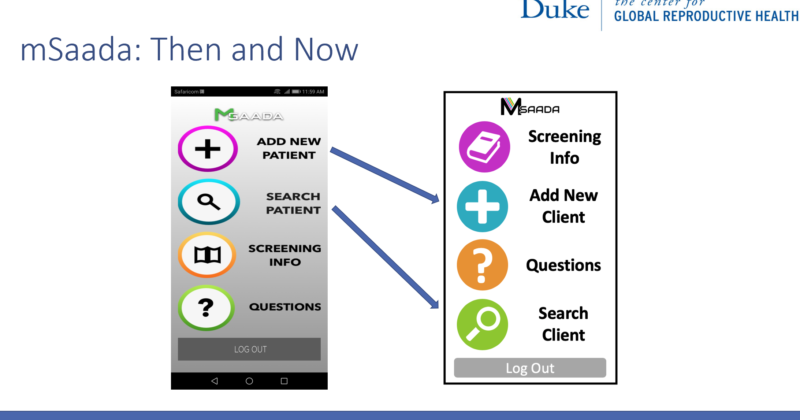
Article by: Emmy Duerr At the DGRH Think Global Talk on October 15, Jacob Stocks presented his work on the mSaada mobile application platform. Prior to his pilot study, Stocks developed mSaada (meaning “support” in Swahili), an application designed to be a support tool for community-based cervical cancer screening for low-income communities. The app was intended to provide counseling/decision support for community health volunteers as well as patient and specimen tracking to better ensure follow up and patient retention. Stocks implemented a small (n = 19) 5-week pilot study in Migori and Kisumu between July and August of 2019. The pilot study consisted of six iterative feedback sessions with the goal of refining the mSaada platform. The first week of the study involved three group sessions with four participants in each session, using a mixed methods approach of a combination of qualitative in-depth interviews and quantitative usability surveys. Weeks 2-4 provided app developers time for feedback integration, and allowed them to implement...
Article by: Sandra Y. Oketch The launch of the HPV vaccination into the routine immunization schedule available for all 10-year old girls from September 2019 onward is a great milestone for Kenya. The Kisumu County launched the HPV vaccine Program on October 25th, 2019 at the Kisumu County Referral Hospital, accompanied by several activities such as HPV health information, speeches and educational entertainment. The Chief Guest of honor was Dr. Dickens Onyang, the Kisumu County Director of Health Services. Onyango voiced that the vaccine has been successfully included in the healthcare cascade of all Government of Kenya health facilities, and that the Ministry of Health will work hand in hand with the Ministry of Education and all other partners to ensure an effective and efficient implementation of the program. He reiterated the benefits of the launch stating, “The HPV vaccine is the silver bullet to prevention of cervical cancer that will greatly reduce the cervical cancer burden as has been in the 115...