Nimmi Ramanujam

Faculty Profile: Nimmi Ramanujam Dr. Nimmi Ramanujam serves as the Robert W. Carr, Jr., Professor of Biomedical Engineering, a Professor of Pharmacology and Cancer Biology, and a Research Professor of Global Health at Duke University. Since arriving at Duke twelve years ago, Dr. Ramanujam has founded the Global Women’s Health Technologies Center and the Tissue Optical Spectroscopy Laboratory, through which she researches cervical and breast cancers, women’s health disparities, and the development of diagnostic tools for implementation in low-resource settings. Her team is currently developing a Point of Care Tampon (POCkeT) Colposcope, which will allow women to screen themselves for cervical cancer.   Dr. Ramanujam took a break from her work to discuss cancer research, technology uptake, and the importance of focusing on the horizon of global health innovation.   How did you decide what technologies to work on?   For Dr. Ramanujam, who had already conducted research on cervical and breast cancers, choosing to concentrate on cervical cancer was about prioritizing the “next generation of problems”...
Read More

Melissa Watt

Faculty Profile: Melissa Watt  With research projects in Tanzania and Ghana, and interests ranging from mother-to-child-transmission of HIV to prevention of fetal alcohol syndrome to family planning to sexual trauma, Associate Professor of the Practice Dr. Melissa Watt is a proficient and passionate force in the field of gender-based health research at Duke.   We sat down with Dr. Watt in her office at the Duke Global Health Institute (DGHI) to learn what sparked her interest in global health, what has defined her time as a Duke faculty member, and what excites her about the future.   How did you become involved in global health and choose reproductive health as a focus for your work?   Referencing a process of self-discovery to which her students might relate, Dr. Watt recalled her undergraduate work in African Studies and Public Policy, which aligned with her passion for “international development and how development can best be transformative for women’s equality and women’s rights.”   After completing her undergraduate program at the...
Read More

Ireland to Vote on Abortion Law Reform

At the end of May, the Irish government will hold a referendum to decide if their long-standing constitutional ban on abortion should be repealed. Currently, unborn fetuses have a right to life equal to living humans, which has been interpreted as a ban on abortion in almost every single circumstance. If the referendum passes, the Irish Parliament will have the power to enact laws regulating abortion. Read the New York Times article for more information on the potential new regulations and Christine Ryan's blog to learn more about abortion law reform. Photo courtesy of: Clodagh Kilcoyne/Reuters  ...
Read More
Cervical Health Awareness Month

Cervical Health Awareness Month

People across the U.S. are kicking off 2018 right with health-conscious resolutions. According to Statista, 45% of Americans hope to “lose weight or get in shape” in 2018. But January offers another opportunity to celebrate and jump-start health awareness: it’s Cervical Health Awareness Month. In the U.S. there are between 11,000 and 13,000 new cases of cervical cancer annually, and cervical cancer is the fourth most prevalent form of cancer among women globally. While patients diagnosed with early-stage cervical cancer have 5-year survival rates of up to 91%, the disease becomes far more deadly as cancerous cells spread to other parts of the body. Fortunately, proactive methods like HPV vaccinations and screenings can keep cervical cancer at bay, and mitigate almost all deaths related to cervical cancer. However, access to such healthcare often depends on a woman’s geographic location and socioeconomic status. According to the WHO, “approximately 90% [of] the 270,000 deaths from cervical cancer in 2015 occurred in low- and middle-income countries.” Duke...
Read More
Human Rights, Feminism, and Abortion Law Reform

Human Rights, Feminism, and Abortion Law Reform

In the seminal international human rights treaties there is no express legal guarantee for abortion rights. Nevertheless, since the 1990s, women’s rights activists have used international human rights forums and mechanisms to advance abortion rights. Cumulatively, human rights law can now be said to call for the decriminalization of abortion and the legalization of abortion in cases where the pregnancy threatens the life or health of the woman, is the result of rape or incest, or there is severe fetal impairment. Despite this promising trajectory, international human rights law does not recognize a woman’s right to decide whether to carry a pregnancy to term as a matter of her autonomy, equality or self-determination. One reason for this is advocates have attempted to follow the path of least resistance for abortion rights and focused instead on the right to health, the right to be free from cruel, inhuman and degrading treatment, and the right to privacy. Recognizing unsafe abortion as a major public...
Read More
The Value of Big Data for Family Planning

The Value of Big Data for Family Planning

While the use of modern methods of contraception are now commonplace in many countries, one-third of women in developing countries who begin using a modern method of contraception quit within the first year and half quit within two years[i]. Most discontinuation occurs among women who want to avoid pregnancy putting them at risk for unwanted pregnancies, maternal morbidity and mortality[ii]. Traditional measures of contraceptive use are collected retrospectively from population representative surveys conducted only every five years which are not well-suited to measuring contemporary trends in contraceptive discontinuation. This is problematic because advocates and health ministries cannot address concerns in a reasonable amount of time to impact widespread change. "Big Data" can supplement these static sources by providing dynamic, real time tracking of the reasons women discontinue using contraceptives and open up possibilities to prevent discontinuation or help facilitate switching between methods. So what exactly is "Big Data" and how can it supplement traditional reproductive health data? Big data is commonly thought...
Read More
Big Data for Reproductive Health

Big Data for Reproductive Health

"Curious about contraceptive discontinuation?  Intrigued by intersections of technology and sexual health?  Apply to join the Data+ “Big Data for Reproductive Health” team! This summer, participants will collaborate with Duke Global Health Institute reproductive health investigators, producing a digital resource that repackages basic Demographic and Health Surveys (DHS) information on contraceptive discontinuation as actionable intelligence for family planning organizations. During the 10-week program, students will also seek feedback from RTI researchers and determine appropriate distribution tactics for their social media-integrated platform. Like other Data+ programs, this project is interdisciplinary, combining the fields of computer science, global health, gender, sexuality and feminist studies, public policy and, of course, data.  To find out more and apply, click here."...
Read More
Recap of Women’s Health Symposium

Recap of Women’s Health Symposium

On Friday, October 20th, public health professionals from around the Triangle gathered at Duke to discuss how best to advance women’s health in the current political environment. Keynote speeches were given by Jen Kates, Vice President and Director of Global HIV Policy at the Kaiser Family Foundation, and North Carolina Congressman David Price. Women’s health right now is in an era of uncertainty. Jen Kates focused on this as she outlined many of the questions that remain regarding how the Trump administration will implement many of its proposed changes to global health policy. Unfortunately, this uncertainty extends to women’s health domestically as well. Congressman David Price described expected and potential changes to the Affordable Care Act and the devastating effect these could have on women and girls across the United States. After hearing a broad overview, the afternoon concluded with two panels which honed in on specific impacts current and proposed policies will have. Lindsay Robinson of Planned Parenthood South Atlantic reminded...
Read More
We Make Inroads

We Make Inroads

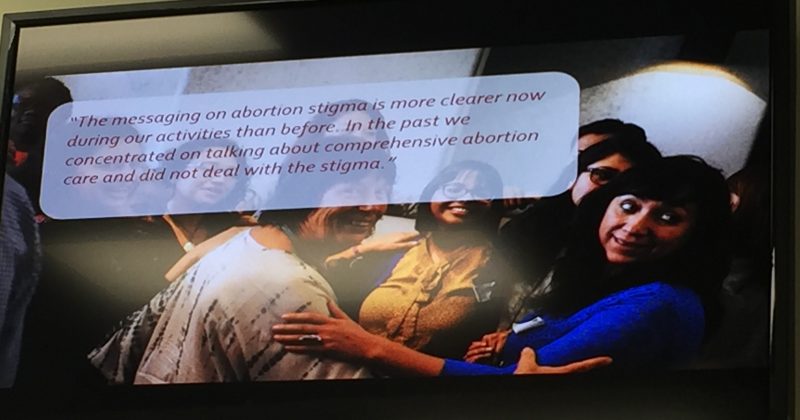
This year, we will host a series of reproductive health talks. These talks are designed to expose audience members to a broad range of reproductive health topics, organizations, researchers, and projects. The first talk of the semester was facilitated by the co-conveners of Inroads. Kati LeTourneau and Katie Gillum gave an engaging presentation on their work and how individuals and organizations are combatting abortion stigma around the world. Rather than being a network of organizations, the Inroads network is comprised of individual members. Gillum and LeTourneau stressed the importance of this, because “we interact with stigma as humans and individuals first” so transforming and dismantling stigma must start on an individual level.  One of their goals is “to transform (stigma) by bringing people together who don’t often get together.” Each member brings their own expertise to the community, provides support to other members, and asks for guidance and feedback from the network. So why stigma? As Kati said, “Stigma is a barrier...
Read More
Can we translate the multilateral strategies for cervical cancer prevention to address other global health disparities?

Can we translate the multilateral strategies for cervical cancer prevention to address other global health disparities?

Cervical cancer is an example of a glaring health disparity between wealthy and poor countries, and remains an immediate health threat to many women in low- and middle-income countries (LMICs). Evidence-based, cost-effective protocols recommended by the World Health Organization have not been widely implemented due to limited health care infrastructure augmented by a lack of funding and political will. Although there are some unique factors contributing to the disparity in cervical cancer outcomes between high and LMICs, there are some common root causes shared across health systems: poor health care infrastructure, lack of awareness of early signs or symptoms, lack of funding prioritization within local governments, and limited operationalization of proven technologies used in high-income countries. These root causes must be addressed through both innovation and adaptation of successful interventions to fit the target community and the priorities of local governments (i.e. be both low-cost and cost-effective). To achieve this, clinicians and researchers need to partner with policy experts and...
Read More