Reflection From the Field: SRT Student, Michelle’s, Reflections in Kisumu

Reflection From the Field: SRT Student, Michelle’s, Reflections in Kisumu

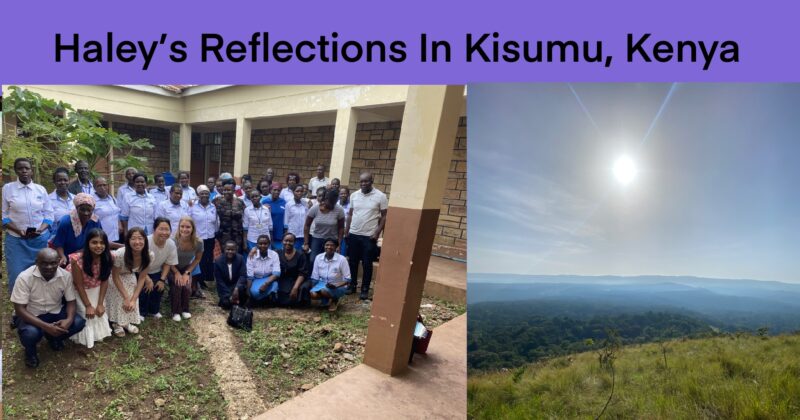
Sunday marked the first full week that the rest of the students from the Kenyan Reproductive Health SRT team and I have been in Kisumu, Kenya. Our experience thus far has been full of introductions and familiarizations, and we have had an exciting time learning from the field while finding our footing in a new area. After we flew into Kisumu, we were able to get situated in our new living space and learn to make ourselves at home for the next two months, starting to cook for ourselves and establishing new rituals (like bonding through watching Suits together during dinner). We have learned to navigate some parts of the town with the help of our local partners, learning where to buy groceries and hot meals, and we have done a bit of exploring on the weekends and our walks to work. Although moving to an unfamiliar area has been challenging, we have been able to improvise and overcome to...
Read More
SRT Spring 2022 Reflection

SRT Spring 2022 Reflection

This summer, 4 students will join the Center as part of the Student Research Training Program (SRT). Hear their thoughts heading into the program.   Bentley Choi When I first applied to the SRT program, I merely expected to ‘conduct’ research abroad. In reality, I learned more important skills such as writing IRB amendments, scheduling a meeting with teammates, and communicating with a research team in Kisumu. My goal for this summer is to apply what I learned from Dr. Eric Green’s Global Health Research Methods class into a real-life setting, and I believe we are making our way to this goal since the team proposed a new way to evaluate the intervention! I look forward to conducting observational study and focus group discussions. Also, I am hoping to learn how to navigate myself in a new living environment and what are Kenya’s unique cultural factors that influence stigma and perception towards reproductive health since it is also related to my senior thesis...
Read More
BD4RH Spring 2022 Reflection

BD4RH Spring 2022 Reflection

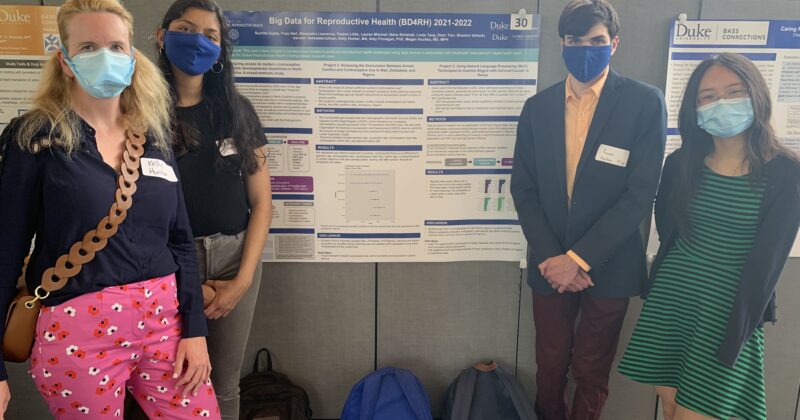
Our Big Data for Reproductive Health Bass Connections team worked on three teams throughout the year and presented their work at the Bass Connections Showcase. Using Natural Language Processing (NLP) Techniques to examine Stigma with Cervical Cancer in Kenya Members: Foxx Hart, Lynne Wang, Alexandra Lawerence, and Neha Shrishail For our project, we utilized topic modeling to identify recurring themes and sentiments in HIV interview data with Kenyan women, as well as develop an understanding of stigma frameworks. This year we were able to learn new technical and project management skills while diving deeper into the emerging interdisciplinary space between quantitative machine learning and qualitative social science research. Due to the many nuances and complexities involved with categorizing stigma, we have concluded that rudimentary NLP is not sufficient for identifying the various forms of stigma in qualitative data. However, we believe that this was a great introduction to applying these methods to an important area in global reproductive health. We hope more research...
Read More
Returning to the Field

Returning to the Field

In March 2022, I was able to return to Kenya to resume my dissertation research. It was wonderful to be back after two years away and to see and work with Kenyan colleagues in person again. I spent part of the time conducting follow-up interviews with sexual and reproductive health NGOs in Kisumu and part of the time preparing to conduct a survey in Migori County later this year. My qualitative work began in February 2020 when I was last in Kenya. I met with several Kisumu-based sexual and reproductive health NGOs to learn about how the US’s global gag rule had impacted their operations, relationships with donors, and relationships with other NGOs. When the pandemic hit and Kenya experienced lockdowns, I along with my undergraduate research assistants Ema Kuczura and Sarah Hubner, conducted semi-structured interviews over zoom with roughly 35 NGOs to understand how they were responding to issues related to the COVID-19 pandemic, including increased demand for their services,...
Read More

Michele O’Shea and her recruitment observations in Kenya

By: Michele O'Shea During October to November 2021, I spent 6 weeks Kisumu Kenya working with our collaborators at Jaramogi Oginga Odinga Teaching and Referral Hospital. Our specific project is aimed at evaluating a new set of illustrations to assess for symptomatic pelvic organ prolapse and urinary incontinence. It is an early step in the process of understanding the burden of pelvic floor disorders in Kenya and informing strategies to better diagnose and treat patients with these conditions. As part of the study, we are asking patients presenting for outpatient care to tell us whether they have the symptoms represented in different illustrations of prolapse, urgency urinary incontinence and stress urinary incontinence. Then, to determine whether the patient clinically has symptomatic prolapse or urinary incontinence, we speak with the patient about her symptoms and perform a brief pelvic exam. From the study’s start, we were plagued by slow recruitment, primarily related to patients declining to undergo a pelvic exam. My co-investigators, Dr....
Read More
Jacob Stocks and his experience working on mSaada

Jacob Stocks and his experience working on mSaada

Duke MsGH ’20, Jacob Stocks, talks about his experience working on an mHealth app to support cervical cancer screening in western Kenya.  The app was developed by four Duke seniors (‘T20) as part of their Computer Science Capstone course. Stocks’ experience co-designing the app with end-users, clinicians and community health volunteers in Kenya, was published recently in JMIR Formative Research. In 2019, I worked alongside members of the Center for Global Reproductive Health to develop and pilot test mSaada, a mobile phone app for use by lay-providers during cervical cancer screening. This experience was an exercise in self-reflection, flexibility, and perseverance, as the study team had to acknowledge the gaps in our intervention and work effectively and efficiently to address them while adapting to additional challenges as they arose. Our team, working face-to-face with local collaborators as well as virtually with app developers, conducted feedback sessions with community health volunteers and clinicians in Kisumu and Migori, Kenya. The main findings of this...
Read More
Adolescent girls and young women are disproportionately affected by COVID-19

Adolescent girls and young women are disproportionately affected by COVID-19

This last summer I worked as a Policy Intern at Friends of the Global Fight Against AIDS, Tuberculosis, and Malaria. Friends of the Global Fight Against AIDS, Tuberculosis, and Malaria advocates for U.S. support and investment in the Global Fund and other health programs by engaging with U.S. policymakers, connecting with key stakeholders, and educating the broader community about improving global health. The COVID-19 pandemic presents serious threats to progress made in the fight against AIDS, tuberculosis, and malaria—specifically, analyses from Imperial College, UNAIDS, the Stop TB Partnership, WHO, and others suggest that the annual death tolls of these three diseases could nearly double due to consequences of COVID-19. As a result, Friends has shifted gears to directly recognize COVID-19 as a leading global health threat. Friends is actively involved in actions to mitigate the spread and effects of COVID-19 and is currently focused on boosting U.S. investment in a global response to the virus.  During my internship, I had the...
Read More

Studying Global, Staying Local

By: Ema Kuczura and Sarah Hubner  When we entered the Student Research Training Program, we were preparing ourselves to deal with many challenges, including learning new research skills and navigating cultural differences. Working with DGHI Doctoral Scholar, Kelly Hunter, our goal was to understand the impact of the Global Gag Rule on health care providers and non-governmental organizations in Western Kenya. The Global Gag Rule formally referred to as the Protecting Life in Global Health Assistance Policy, “aims to ensure that US tax-payer funding does not support foreign non-governmental organizations that perform or actively promote abortion as a method of family planning” (Michael Pompeo, US Secretary of State). We were planning on using our time in Kisumu to conduct in-person interviews with stakeholders in the reproductive health sector. However, when we heard the news that pandemic would make it impossible to travel to Kenya as we initially anticipated, we knew achieving the goals we set forth for the summer would require newfound...
Read More

Effects of COVID-19 on Sexual Reproductive Health and Rights (SRHR) among Young People in Africa

By: Sandra Y. Oketch Mid-April, I was privileged to join the Live webcast on discussions around the Effects of COVID-19 on Sexual Reproductive Health and Rights (SRHR) among young people in Africa. The panelists included experts in the medical, advocacy, and policy fields: Dr. Charlene Biwott (KEMRI, Kenya), Millicent Sethaile (Her Voice Ambassador, Botswana), and Levi Singh (Youth SRHR Strategy Officer, South Africa). The moderator was Evelyne Odhiambo (AfNHi Youth Cohort, Kenya). Important to note were conversations around the vulnerability of young people during this pandemic where the younger populations have so far been the least vulnerable to complications and death from COVID-19 and yet play a very key role in flattening the COVID-19 curve by minimizing transmissions to the vulnerable populations in our society that include the immune-compromised and the elderly. Currently, there has been a great shift of focus in Africa to cater to the COVID-19 pandemic thereby impacting negatively in other areas including SRHR. Some of the effects on...
Read More
Pilot Study: Use of mSaada Application to Address Cervical Cancer in Kenya

Pilot Study: Use of mSaada Application to Address Cervical Cancer in Kenya

Article by: Emmy Duerr At the DGRH Think Global Talk on October 15, Jacob Stocks presented his work on the mSaada mobile application platform. Prior to his pilot study, Stocks developed mSaada (meaning “support” in Swahili), an application designed to be a support tool for community-based cervical cancer screening for low-income communities. The app was intended to provide counseling/decision support for community health volunteers as well as patient and specimen tracking to better ensure follow up and patient retention. Stocks implemented a small (n = 19) 5-week pilot study in Migori and Kisumu between July and August of 2019. The pilot study consisted of six iterative feedback sessions with the goal of refining the mSaada platform. The first week of the study involved three group sessions with four participants in each session, using a mixed methods approach of a combination of qualitative in-depth interviews and quantitative usability surveys. Weeks 2-4 provided app developers time for feedback integration, and allowed them to implement...
Read More