By: Sandra Y. Oketch The Duke Center for Global reproductive health Kenya team had an interactive session on October 29, 2019 with the Ministry of Health and CSOs to discuss on Reproductive Maternal Neonatal Child and Adolescent Health (RMNCAH) and Immunization advocacy to ensure proper budgeting and sustainability. The discussions revolved around the critical pillars in budgeting that include: transparency and accountability; public participation and strategic planning. Some of the gaps in the Kisumu County Annual Development Plan (ADP) included: The lack of clear cut priorities for the FY 2019/20 and the public participation is not prioritized nor costed. All members present acknowledged the need for advocacy on the key stages in budgeting that include budget formulation, approval, implementation and Auditing. It was an exciting 1st advocacy collaborations to push for more transparent budget cycle on RMNCAH + Immunization with the CSO roles revolving around providing support in dissemination of the National County RMNCAH + Immunization policies and guidelines; Organize and conduct sensitization...
To commemorate World AIDS Day held each year on December 1, we are highlighting Dr. Elizabeth Bukusi’s HIV research in Kenya! Dr. Bukusi is one of the foremost advocates for HIV care. She has conducted various studies in evaluating treatment options for high-risk populations. In one of her recent studies, she explored the value of post-exposure prophylaxis (PEP) and the antibiotic doxycylcine (dPEP) as an STI prevention strategy in African women taking PrEP, PrEP, or HIV pre-exposure prophylaxis, has been used over the past decade to prevent against HIV, however, there has also been a rising incidence of curable STIs in populations taking PrEP. The disproportionate risk that African women face from overlapping HIV-STI epidemics makes them an essential study population. dPEP is beneficial because it can be "woman-controlled," meaning that the effectiveness is not determined by partner participation, and that it's been shown to be safe for women. Dr. Bukusi predicts that dPEP will lead to a substantial reduction in the amount of...
By Eugene Wang and Dennis Harrsch On November 21st, members of the Big Data for Reproductive Health (bd4rh) Bass Connections research team visited IntraHealth, a Chapel Hill-based international development nonprofit. While there, they presented to IntraHealth staff about the team’s work, with research lead Amy Finnegan, PhD speaking additionally about the value proposition of data science for the development space. The bd4rh team is split into two main subteams: the machine learning (ML) team, and the research and policy stakeholder (RAPS) subteam. The ML team has been working on developing machine learning algorithms to accurately predict a woman’s contraceptive use patterns based on demographic survey data. They hope to integrate any promising results into their online tool, currently hosted as a website application that displays contraceptive use data through a easy-to-understand visual interface. The RAPS team has been identifying use cases for such a tool by interviewing stakeholders in order to shape the project’s trajectory and maximize deliverable value. The bd4rh team is...
The end of the semester and calendar lend themselves to reflections on the progress and challenges of the past year, and global health is no exception. In fact, last year we highlighted some of the year’s ups and downs in reproductive health. Both myself and Konyin Adewumi, DGHI MSc ’17, concluded that despite some setbacks, 2018 left us optimistic about progress toward reproductive and sexual health, reflected in a global call toward cervical cancer elimination, a historic decision on abortion rights in Ireland and a record number of women seeking (and achieving) government office in the United States and around the world. This year, the 25th anniversary of the International Conference on Population and Development (ICPD) facilitates reflections on not just the past year, but the past 25 years of achievements in global reproductive health. The momentous discussion at the ICPD in Cairo, Egypt and the resultant 20-year Programme of Action were pivotal in shaping the agenda in women’s health around...
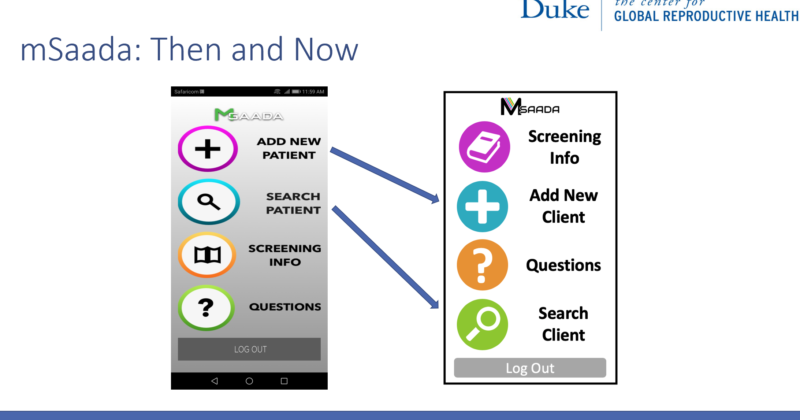
Article by: Emmy Duerr At the DGRH Think Global Talk on October 15, Jacob Stocks presented his work on the mSaada mobile application platform. Prior to his pilot study, Stocks developed mSaada (meaning “support” in Swahili), an application designed to be a support tool for community-based cervical cancer screening for low-income communities. The app was intended to provide counseling/decision support for community health volunteers as well as patient and specimen tracking to better ensure follow up and patient retention. Stocks implemented a small (n = 19) 5-week pilot study in Migori and Kisumu between July and August of 2019. The pilot study consisted of six iterative feedback sessions with the goal of refining the mSaada platform. The first week of the study involved three group sessions with four participants in each session, using a mixed methods approach of a combination of qualitative in-depth interviews and quantitative usability surveys. Weeks 2-4 provided app developers time for feedback integration, and allowed them to implement...
Article by: Sandra Y. Oketch The launch of the HPV vaccination into the routine immunization schedule available for all 10-year old girls from September 2019 onward is a great milestone for Kenya. The Kisumu County launched the HPV vaccine Program on October 25th, 2019 at the Kisumu County Referral Hospital, accompanied by several activities such as HPV health information, speeches and educational entertainment. The Chief Guest of honor was Dr. Dickens Onyang, the Kisumu County Director of Health Services. Onyango voiced that the vaccine has been successfully included in the healthcare cascade of all Government of Kenya health facilities, and that the Ministry of Health will work hand in hand with the Ministry of Education and all other partners to ensure an effective and efficient implementation of the program. He reiterated the benefits of the launch stating, “The HPV vaccine is the silver bullet to prevention of cervical cancer that will greatly reduce the cervical cancer burden as has been in the 115...
Sandra Oketch, the Kisumu Research Director for the Center has been making the rounds of the radio talk shows to share information about human papillomavirus testing in anticipation of this week’s cancer awareness activities. During this media blitz, Oketch has been speaking on radio shows in Luo, Kiswahili and English, she is working with key members of the Ministry of Health to raise awareness of cervical cancer, educate women on their risk and how to get screened. Activities will include in-person education, screening and a cancer awareness walk on the second and third of October. Key stakeholders will take advantage of the momentum to convene of meeting of partners actively engaged in cancer prevention and treatment to help develop a cancer prevention alliance that works synergistically, without duplication of activities. The First Lady of Kisumu, Dorothy Nyong’o, long a supporter of cancer control activities in the region, has promised to serve as a patron for the Kisumu County Cancer Alliance....
This summer I worked as a Legislative Assistant on the Government Relations, Advocacy, and Community Engagement (GRACE) team at the Anti-Defamation League (ADL) in Washington, DC. The mission of the ADL is to stop the defamation of the Jewish people and secure justice and fair treatment for all. Among the organization's core policy issues is protecting religious freedom by ensuring separation of Church and State. The ADL advances separation of Church and State by filing amici briefs in nearly every religious freedom case. Moreover, the ADL supports legislation such as the Do No Harm Act that ensures religious freedom cannot be misused to discriminate. Throughout my internship, I had the opportunity to attend hearings, write blog posts, and write public comments in response to different issues related to religious freedom such as LGBTQ equality and access to healthcare. Throughout college, my policy interests have been focused on domestic and global women’s health issues. My passion for reproductive health is rooted in...
It’s been about a month since I returned from Kisumu, where I spent eight weeks working on the development of an mHealth pilot study at the Duke Center for Global Reproductive Health. I really feel that I gained so much out of those two months, and I’m hoping to bring these lessons with me to my senior year at Duke. I was able to experience what it really means to do research in the field, and that a lot of the time this means being flexible and prepared for plans to constantly change. The local team at the Center taught me the importance of communication and planning ahead, but how to also be ready for scheduling changes when working with outside teams. More than that though, the team showed me how easily one can feel connected to a new group of coworkers that welcome you with open arms. I think I speak for myself and the rest of the SRT...
I traveled this summer to Kisumu, Kenya expecting to work on a project we had poured hours of work into through the Center for Global Reproductive Health. After much time spent discussing our project, conducting literature reviews, and finalizing on our in-depth interview guides, it was disappointing to learn that we would not have our necessary IRB approvals for our project until after our departure from Kisumu. While we are glad to know that our project is in amazing hands here at the Center for Global Reproductive Health, it was frustrating to come to terms with the fact that we would not be the ones to carry out the interviews we had worked so hard on. As I look back on my summer, I am compelled to reflect on why this change of plans changed my trip for the better. Much discussion around research, especially when it comes to global health research, focuses on the importance of flexibility. Figuring out what...