Meet Our Research Team in Kisumu, Kenya This Summer

Meet Our Research Team in Kisumu, Kenya This Summer

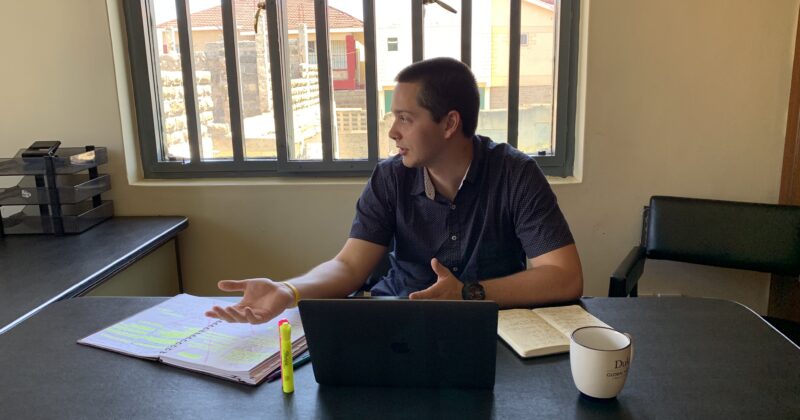
This summer, we have 5 Duke Scholars working with the Duke Center for Global Reproductive Health in Kisumu, Kenya. We have 3 undergraduate students joining the Center as part of the Student Research Training Program (SRT), a Masters of Global Health Student, and a 3rd year OB/GYN resident all conducting research in Kenya. Read below to learn a bit about these passionate students and hear about their work and what they are most looking forward to.    SRT Students: Sydney Chen (she/her) Sydney is a double major in Global Health and International Comparative Studies with a Biology Minor. She calls Herndon, Virginia home. When asked about what her time spent in Kisumu looks like, she reflected that “The team and I are working on various ways to improve an app called mSaada which helps women in East Africa receive screening for cervical cancer. I’m specifically working on the FAQ portion of the app by making sure that the answers are clinically accurate and using...
Read More
Jacob Stocks and his experience working on mSaada

Jacob Stocks and his experience working on mSaada

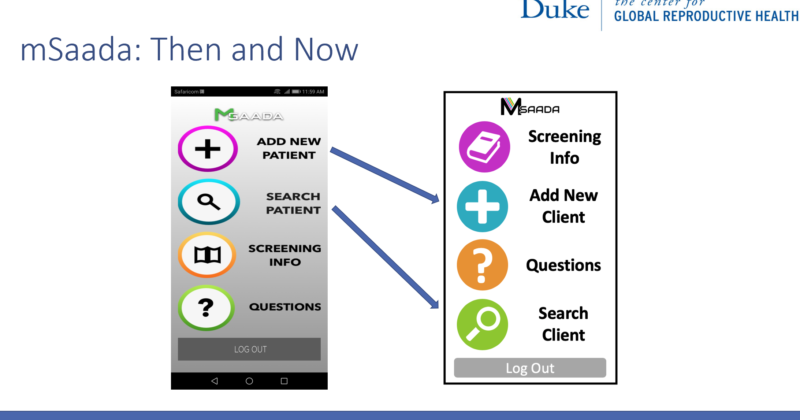
Duke MsGH ’20, Jacob Stocks, talks about his experience working on an mHealth app to support cervical cancer screening in western Kenya.  The app was developed by four Duke seniors (‘T20) as part of their Computer Science Capstone course. Stocks’ experience co-designing the app with end-users, clinicians and community health volunteers in Kenya, was published recently in JMIR Formative Research. In 2019, I worked alongside members of the Center for Global Reproductive Health to develop and pilot test mSaada, a mobile phone app for use by lay-providers during cervical cancer screening. This experience was an exercise in self-reflection, flexibility, and perseverance, as the study team had to acknowledge the gaps in our intervention and work effectively and efficiently to address them while adapting to additional challenges as they arose. Our team, working face-to-face with local collaborators as well as virtually with app developers, conducted feedback sessions with community health volunteers and clinicians in Kisumu and Migori, Kenya. The main findings of this...
Read More
Pilot Study: Use of mSaada Application to Address Cervical Cancer in Kenya

Pilot Study: Use of mSaada Application to Address Cervical Cancer in Kenya

Article by: Emmy Duerr At the DGRH Think Global Talk on October 15, Jacob Stocks presented his work on the mSaada mobile application platform. Prior to his pilot study, Stocks developed mSaada (meaning “support” in Swahili), an application designed to be a support tool for community-based cervical cancer screening for low-income communities. The app was intended to provide counseling/decision support for community health volunteers as well as patient and specimen tracking to better ensure follow up and patient retention. Stocks implemented a small (n = 19) 5-week pilot study in Migori and Kisumu between July and August of 2019. The pilot study consisted of six iterative feedback sessions with the goal of refining the mSaada platform. The first week of the study involved three group sessions with four participants in each session, using a mixed methods approach of a combination of qualitative in-depth interviews and quantitative usability surveys. Weeks 2-4 provided app developers time for feedback integration, and allowed them to implement...
Read More
Learning Lessons the Harder Way

Learning Lessons the Harder Way

Fieldwork is all about learning, and sometimes that means learning things the hard way. My summer in Kenya taught me a lot about app development, about the process of global health research, and, of course, about myself.  My apologies to those of you who have been following the student pieces throughout the summer, but I’ll give a quick summary of my thesis project for first time readers: mSaada is a mobile phone application intended for use by community health volunteers (CHVs) during cervical cancer screening in Western Kenya. The app has multiple features including patient education and counseling materials, protocol support for CHVs, and patient data collection capabilities, to name a few. We hope the app will increase patient understanding of HPV and cervical cancer and act as an efficient and effective resource for CHVs throughout the screening process, leading to greater uptake of cervical cancer screening and treatment services and ultimately improved health outcomes for Kenyan women. Since the app...
Read More
mSaada User Testing with Community Health Volunteers in Kisumu Kenya

mSaada User Testing with Community Health Volunteers in Kisumu Kenya

Together with Duke SRT students, undergraduate app developers, and Kenya-based members of the Center for Global Reproductive Health, I will be leading a pilot usability study of an integrated digital platform called mSaada. The goal of this platform, placed in the hands of community health volunteers (CHVs) during HPV-based cervical cancer screening, is to help facilitate the successful completion of the cervical cancer prevention cascade. This will be achieved by mSaada’s many features: patient education, protocol and counseling support for CHVs, results notification, service reminders, and patient tracking. Over the course of the summer, we will train CHVs on proper use of mSaada, allow them to use the app in a clinical setting, and gather periodic feedback through quantitative questionnaires and structured in-depth interviews. We aim to gain a strong understanding of user experience, acceptability, and feasibility of the mSaada platform within the context of Western Kenya. My interest in this project is multifactorial. First, by studying and working to combat...
Read More
Stakeholders Meeting on Palliative Care and Treatment of Cervical Cancer

Stakeholders Meeting on Palliative Care and Treatment of Cervical Cancer

By: Jacob B. Stocks & Sandra Yvonne Oketch - June 18th, 2019 On May 23rd, 2019, a stakeholders meeting on palliative care and treatment of cervical cancer for partners in Kisumu County was hosted at the KMET Complex in Kisumu. The main objectives of the meeting were 1) to share experiences on palliative care and cervical cancer services in Kisumu County and 2) to identify opportunities for networking and collaboration among partners. The 7-hour meeting began with a discussion of structural barriers to effective referral and treatment of cervical cancer in Kisumu County. The presenter, Brenda Otieno, discussed barriers such as the complexity of intra-facility referrals and client tracking, the lack of centrally located data on cancer patients (i.e. lack of a county-level cancer registry), and the lack of financial protection for clients seeking treatment. Following this session, Dr. Chemtai Mungo, an OB/GYN from UCSF, presented the evidence for cervical cancer screening via HPV testing by citing multiple studies discussing the cost-effectiveness...
Read More
Mhealth App User Training

Mhealth App User Training

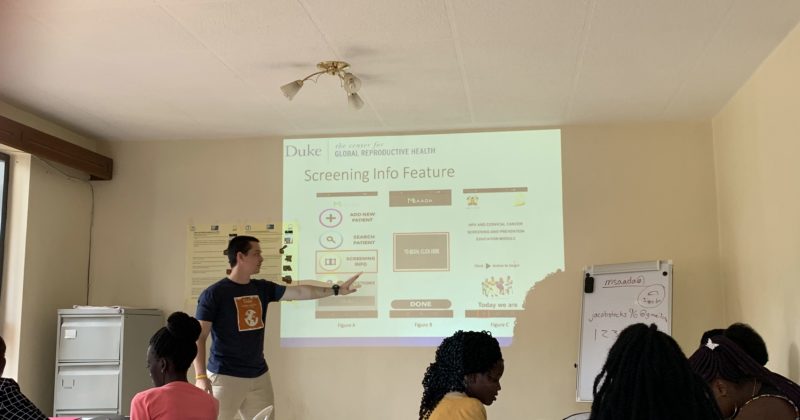
In order to ensure participants had a strong understanding of mSaada and the planned pilot usability study, members of the mSaada study team hosted a two-day training, June 6th and 7th, at the Kisumu Office of the Center for Global Reproductive Health. Twelve study participants, four researchers, and two research assistants were in attendance. The first day of the training began with a general overview of research, its importance, those involved, and a lengthy discussion of informed consent. After a tea break, we proceeded with a discussion of HPV and cervical cancer, and prevention, screening, and treatment strategies. In addition to lively audience participation during a session of review questions, each study participant displayed their understanding of the steps necessary to successfully complete HPV self-collection by demonstrating how to explain the process to a female client. Finally, the first day of training concluded with a 2-hour session on mhealth strategies and details of the planned mSaada pilot usability study. Day two of...
Read More
Small Fish, Big Conference: Lessons from an early career researcher on navigating your first international conference

Small Fish, Big Conference: Lessons from an early career researcher on navigating your first international conference

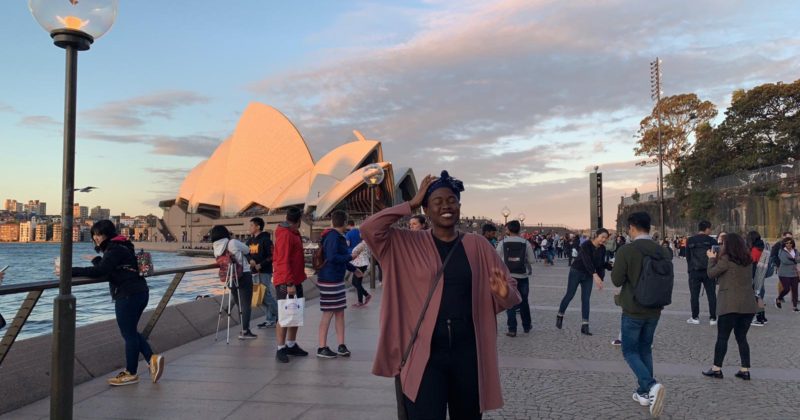
Guest Blog by Konyin Adewumi, MSc-GH '17 Last month, I was given the opportunity to present my research work at the International Papillomarvirus Conference in Sydney, Australia. I submitted an abstract entitled, “Female perspectives on male involvement in a human papillomavirus-based cervical cancer screening program in western Kenya”; a qualitative analysis that was part of an ongoing study at Duke’s Center for Global Reproductive Health. After taking the time to reflect on my experiences navigating such a great opportunity, I found that I had learned a few lessons that may be beneficial to others who are in my shoes – anyone that is early in their research career, unsure where the path is headed, but eager to make the most of the opportunities presented to you.     So here are my five lessons: One. Similar to your fieldwork, what can go wrong will go wrong. Plan accordingly—and when all else fails, learn to pivot. From arriving to the airport to find out that I...
Read More
Notes from the Field: Dissemination Meeting for a Community Health Volunteer Study

Notes from the Field: Dissemination Meeting for a Community Health Volunteer Study

The Center for Global Reproductive Health's Research Coordinator, Yujung Choi, and I held a dissemination meeting on October 19th to share the findings from one of our studies. The study describes the characteristics, motivations, and experiences of community health volunteers (CHVs) in Kisumu county, and looks to understand CHV knowledge and self-efficacy of reproductive health counseling and services. The purpose of the meeting was to share the study outcomes with key stakeholders and elicit feedback in order to inform future interventions to measure CHV performance and increase CHV retention rates. Among those who attended the meeting were CHV supervisors who had participated in the study, Sub-County Community Health Strategy Focal Persons, a former study staff, and a Program Officer from the NGO Community Initiatives Concerns. We summarized the study findings on various topics, including: -CHVs’ reasons for becoming CHVs -CHV level of comfort in teaching health topics such as family planning -child care and nutrition -HIV, malaria, and cervical cancer -challenges in carrying out daily tasks -relationship...
Read More
So… what are you going to do about it?

So… what are you going to do about it?

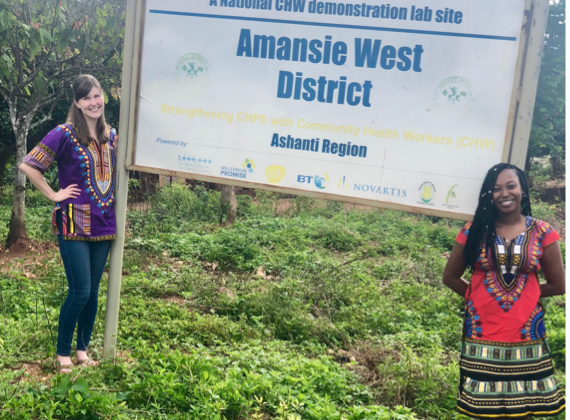
I’m currently in Amansie West, Ghana as part of a team conducting research on the barriers and facilitators to family planning use and the role community health workers play in family planning uptake. During this time, I was invited to attend Ghana Health Service’s first National Maternal, Child Health and Nutrition Conference by Millennium Promise,  a co-sponsor of the conference and our collaborator in country. The collaboration with Millennium Promise first began back in September when Chief Nat Ebo Nsarko, the Country Director visited Duke University. From the beginning this team has been our guide for conducting research in Ghana through assisting us in each task and facilitating our learning experience. It is through their contributions and dedication which have allowed this research to not only be possible but successful. The theme of the conference was “Strengthening Partnerships for Achieving Universal Health Coverage in Reproductive, Maternal, Newborn, Child and Adolescent Health and Nutrition.” Gladys Ghartey (Head of UN System Unit at...
Read More
12