Resources for Abortion Access Across a Post-Roe Nation

Resources for Abortion Access Across a Post-Roe Nation

Pictured above: People marching in Boulder, Colorado for Reproductive Health Rights in May of 2022 with signs that say “Your right to abortion should not depend on your zip code.”   Unfortunately, though, zip codes shaping access to abortions may very much be more of a reality with the overturning of Roe v. Wade.    The New York Times reveals how the Supreme Court’s ruling on the Mississippi law could weaken or even overturn Roe v. Wade which could ultimately lead to legal abortion access dramatically decreasing, particularly in the American South and Midwest (Bui et al., 2021). This geographic discrepancy is even more reinforced through social class differences and communities that are “disproportionately Black, Latina, teenagers, uninsured, and undocumented immigrants” (Miller & Sanger-Katz, 2022). Ultimately, leading not only to be a social justice issue and human rights issue, but also a racial justice issue. Bui et al. quotes Caitlin Knowles Myers saying, “A post Roe-United States isn’t one in which abortion isn’t...
Read More
Faculty Spotlight:  An Interview with Dr. Jonas Swartz

Faculty Spotlight: An Interview with Dr. Jonas Swartz

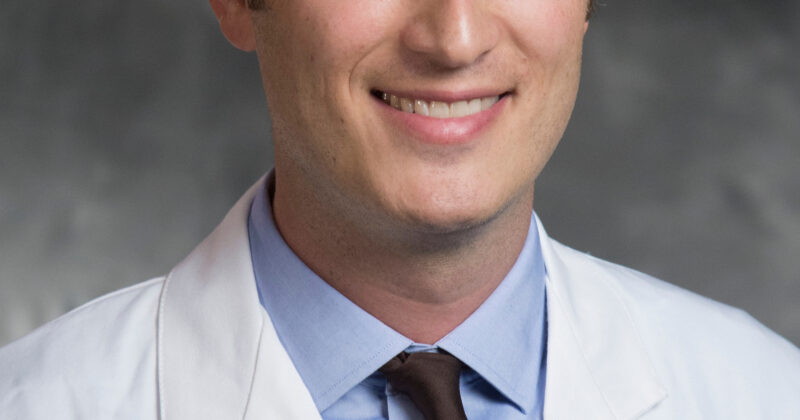
Jonas Swartz, MD, MPH is an OB/GYN and an Assistant Professor of Obstetrics and Gynecology. He completed his undergrad at Duke University and then his MPH and MD at the University of North Carolina at Chapel Hill. He completed his residency in Obstetrics and Gynecology at the Oregon Health and Science University, followed with a fellowship in Complex Family Planning back at UNC. I had a conversation with Dr. Swartz to understand more about how he became involved in health policy and reproductive health access. “Well, I grew up in North Carolina and did Medical School here, and one of the striking things when I was a medical student was the discrepancy in care during pregnancy for people who were citizens versus non-citizens. And, in particular, thinking about low-income people who use Medicaid.” Swartz described his early medical training and becoming acquainted with the Federal Emergency Medicaid program, which only pays for labor and delivery services for authorized immigrants. He noted that...
Read More
BD4RH Spring 2022 Reflection

BD4RH Spring 2022 Reflection

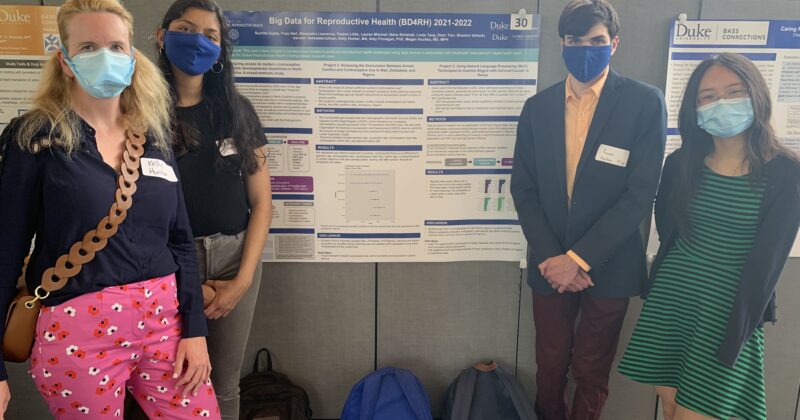
Our Big Data for Reproductive Health Bass Connections team worked on three teams throughout the year and presented their work at the Bass Connections Showcase. Using Natural Language Processing (NLP) Techniques to examine Stigma with Cervical Cancer in Kenya Members: Foxx Hart, Lynne Wang, Alexandra Lawerence, and Neha Shrishail For our project, we utilized topic modeling to identify recurring themes and sentiments in HIV interview data with Kenyan women, as well as develop an understanding of stigma frameworks. This year we were able to learn new technical and project management skills while diving deeper into the emerging interdisciplinary space between quantitative machine learning and qualitative social science research. Due to the many nuances and complexities involved with categorizing stigma, we have concluded that rudimentary NLP is not sufficient for identifying the various forms of stigma in qualitative data. However, we believe that this was a great introduction to applying these methods to an important area in global reproductive health. We hope more research...
Read More
May 2022 Director’s Message

May 2022 Director’s Message

May is a time of growth and excitement, from magnolia blooms and longer, warmer days to the celebrations popping up around campus. Along with the inherent optimism of spring on Duke’s campus, it feels that we are starting to sense what life in a more stable peri-Covid world will look like. For many, getting together in person to celebrate events and achievements, or even just to brainstorm in the same room, is a salve after these past two years. Graduation and summer opportunities provide a blank canvas for new experiences and adventures for students. This year’s graduating class spent much of their time at Duke in conditions altered by the pandemic, and yet most of the ones that I have worked with have not let that hinder their ambition or achievements. Their resilience, flexibility and grace will serve them well. In fact, the confluence of the pandemic and the national reckoning with race and racism that has so profoundly impacted...
Read More

Hybrid GRH

Our paper, “Uptake and correlates of cervical cancer screening among women attending a community-based multi-disease health campaign in Kenya,” is published in the BMC Women’s Health. In this paper, we describe the acceptability and uptake of a model of integrated HPV-based cervical cancer screening as part of a series of multi-disease community health campaigns offered in Kisumu, Kenya. We also describe the prevalence and predictors of both screening and positive HPV results among women attending these campaigns. Although there is an increased risk of cervical cancer among women living with HIV, many HIV-care programs do not offer integrated cervical cancer screening. To address the cervical cancer screening gap in Kenya, we leveraged the community health campaigns facilitated by the Family AIDS Care & Education Services and provided multi-disease testing to achieve a high population coverage for HIV-testing and HPV-based cervical cancer screening in western Kenya, an area with high rates of HIV. In addition to HIV testing, the campaigns provided screening...
Read More
From Dormmates to Research Collaborators

From Dormmates to Research Collaborators

In fall 2019, when Rachel Mundaden and Ramya Ginjupalli (T’22) applied to spend the following summer in Kisumu, Kenya, as part of the Center’s Student Research Training program, no one could have predicted the COVID-19 pandemic, and the resultant global disruptions in almost every aspect of people’s lives.  Travel and fieldwork were soon out of the question, but these two were able to pivot to develop the content expertise and skills in qualitative methods necessary to carry out an analysis of focus groups discussions designed to better understand stigma related to cervical cancer and human papillomavirus in Kenya.  They spoke to DGHI about their experience and how it felt to have a published manuscript resulting from this work. Check it out here: https://globalhealth.duke.edu/news/dormmates-research-collaborators    ...
Read More
Director’s Blog February 2022

Director’s Blog February 2022

The new year often inspires us to reflect on our goals and priorities, an endeavor supported by a series of opportunities to recognize, learn about and celebrate different events and people. January was Cervical Cancer Awareness Month, February is Black History Month and March is Women’s History Month, including International Women’s Day on March 8. This year’s International Women’s Day theme is #BreaktheBias, offering to challenge various the biases people face around the world, including gender and race. The subjects explored over these months are all central to the work of the Center, and among other things, illustrate the impact of marginalization and discrimination on health outcomes. The intersection of race, gender and reproductive health is perhaps best shown by the experience of Henrietta Lacks, the Black woman whose cervical cancer cells gave rise to the immortal “HeLa” cell line. HeLa cells have played an extraordinary role in scientific research, underlying multiple Nobel Prize-winning discoveries and enabling medical advances for...
Read More

Faculty Spotlight: An Interview with Dr. Sumedha Ariely

Dr. Sumedha Gupta Ariely is an associate Professor in the Global Health department and teaches courses such as Research methods in Global Health (GLHLTH371) and Global Health Ethics (GLHLTH373). She is also a faculty lead for Duke Global Health Institute’s Durham Research and Service work, demonstrating her commitment to the “Local-is-Global” approach in global health endeavors. She has mentored a variety of undergraduate and graduate students through Bass Connections and DukeEngage projects. In her research, she investigates maternal, child, and adolescent health across international contexts. Notable, she has worked extensively with Uganda, Kenya, and India across her time at Duke. Using her background in developmental psychology, she examines how cultural and social factors relate to a community’s health behaviors and outcomes. To explore more of Dr. Ariely’s revolutionary work, I interviewed her on her experiences and initiatives in the global health field during her time at Duke to see how they have informed her research. 1. You’ve led initiatives in the “Global Is...
Read More
Contraceptive Calendar

Contraceptive Calendar

Our team seeks to understand how conflict impacts contraceptive use using data from Sub-Saharan African countries. More specifically, we are looking at trends in contraceptive use for women in the time preceding, during, and following the conflict period--to do so, we are utilizing geocoded data for sub-Saharan Africa from the Uppsala Conflict Dataset and contraceptive calendar data from the Demographic and Health Surveys. This research has important implications for women’s health: firstly, it can help us understand the demographic consequences of conflict on family planning, births, and outcomes, and secondly, it can help inform policy interventions that can target and improve reproductive health in humanitarian settings. We are personally interested in this project because, collectively, our team is passionate about understanding health inequities and empowering women by leveraging policy as a tool. Participation in this project can help to provide us a foundational understanding of how conflict interacts with women’s reproductive autonomy in a way that gives us independent research...
Read More

Natural Language Processing Group

We are the Natural Language Processing group from the Big Data for Reproductive Health Bass Connections team. Our names are Lynne Wang, Foxx Hart, Alexandra Lawrence, and Neha Shrishail. Currently, we are working through “Text Mining with R” to gain a better understanding of text mining, sentiment analysis, and topic modeling. Additionally, we are examining the stigma summary scale as well as other texts related to stigma to form a solid foundation on the resources at hand. We are interested in this project for the opportunity to learn new technical and project management skills, as well as dive deeper into the emerging interdisciplinary space between quantitative machine learning and qualitative social science research. We’re especially excited to apply these methods to an important area in global reproductive health. At the end of our research, we hope to become proficient in using natural language processing and gain a better understanding of how it can be applied to future projects....
Read More